UAE University Study Points to Fewer but Fiercer Rain Days
Rainfall across the UAE is likely to fall on fewer days but hit far harder when it does, according to a new study by researchers at UAE University (UAEU) in Al Ain, published in the journal Water Cycle. The analysis, titled "Precipitation analysis under Climate Change Impacts over the United Arab Emirates," projects that by the end of the century the wettest days could carry twice as much rain as they do now, with average rainfall on wet days potentially more than five times current levels. Under a high-emissions scenario, the study found average rainfall on wet days could rise by as much as 466 per cent compared with 1995-2014 levels, while the annual maximum daily rainfall could more than double, up 106 per cent over the same period.
Researchers Abdalmonem Alkhawaga of UAEU and Tanta University in Egypt, and Professor Mohamed Mohamed of UAEU, wrote that "the future climate is expected to experience fewer rainy days" even as intensity on those days climbs at most UAE weather stations. Dr Diana Francis, head of the Environmental and Geophysical Sciences Lab at Khalifa University in Abu Dhabi, said the findings were broadly in line with her own group's research, though she noted some studies point to rain becoming both more frequent and more intense rather than rarer overall. Her team has separately found the number of stormy days in the UAE has risen by up to two per year since 2000, with three to four additional stormy days a year possible by century's end compared with a 2015 baseline. Bob Ward of the Grantham Research Institute on Climate Change and the Environment at the London School of Economics said a warmer atmosphere holds more moisture, so "when it rains it rains harder than in the past," and warned the trend will keep worsening until the world reaches net zero emissions.
Dubai's Dh30 Billion Tasreef Programme Races to Keep Pace
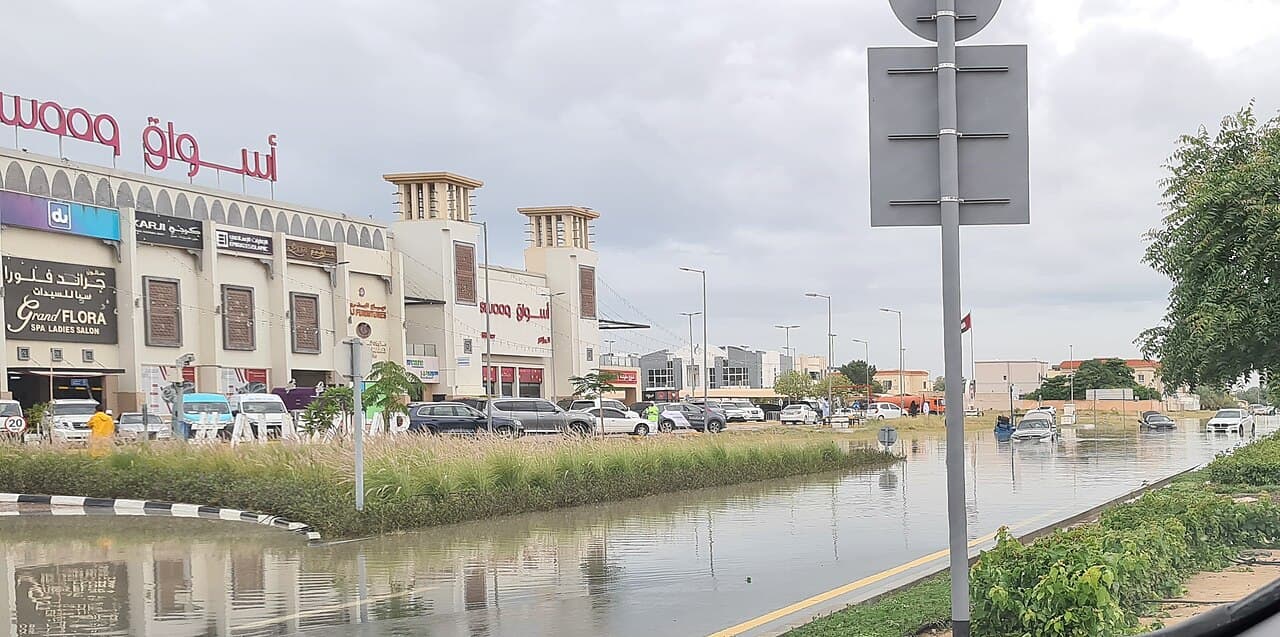
The stakes were laid bare in April 2024, when the UAE and Oman were hit by severe flooding after Al Ain received two years' worth of rain in a single day, leaving many Dubai streets underwater. The country was hit again by powerful, though less severe, storms in March 2026, causing further flooding and travel disruption. "In the arid built environment, an increase in rainfall can indeed increase the risk of flooding because the current drainage and stormwater management infrastructure is designed for low rates of rainfall," Dr Francis said, echoing the study's own warning that the shift matters for flood-risk assessment, stormwater design and water-resources planning in arid regions like the UAE.
In response, Dubai has been steadily building out its Dh30 billion Tasreef programme, designed to expand the emirate's drainage capacity roughly eight-fold over 100 years using tunnels, pumping stations and AI-based flood monitoring. Dubai Municipality completed the first phase of a Dh500 million sewerage and stormwater project for Al Quoz in April 2026, adding 15km of sewerage pipelines and 14km of stormwater drainage networks, and in February 2026 awarded a further AED2.5 billion in contracts covering 30 areas spanning about 430 million square metres, home to an estimated three million residents by 2040. Sharjah is separately investing heavily in its own drainage upgrades. "We've been seeing countries in the Gulf region... suffering with such events," Ward said. "It can destroy infrastructure, offices and homes. It can kill as well. Every country needs to be able to manage these risks."